Key takeaways (TLDR)
- GCalSync started as a small internal fix, but it exposed a much bigger truth: the moment software manages time, trust becomes the product.
- We built it narrowly on purpose. It mirrors calendars, protects privacy, and resists the usual drift into a bloated scheduling or productivity suite.
- The real complexity lived below the surface: auth, webhooks, recurring events, cancelled-event handling, rate limits, recovery logic, and all the invisible work required to make a background utility dependable.
- The broader lesson is not just about calendar sync. It is about product discipline. Not every useful piece of software should expand. Sometimes the better strategy is to stay close to the core job and make it work so well people stop noticing it.
Most product stories start with a market gap. This one started with a headache.
We were working across personal calendars, work calendars, and client calendars. Meetings lived in different Google accounts. Availability existed in theory, but not in practice. We could see our own scattered schedules, but teammates still could not reliably tell when we were actually free. Personal commitments had to stay private, but the time still needed to be blocked. So the same workaround kept happening: manual busy blocks, copied events, cross-checking calendars, and the occasional avoidable conflict.
That kind of problem sounds too small to deserve a real product. It feels like something you should solve with a script, a zap, or better habits. That was our first lesson. Some of the most annoying workflow problems look trivial from far away. They stop looking trivial the second you try to make them dependable.
GCalSync began as an internal fix. We already had a rough script that handled calendar syncing for one person. The real opportunity was not the script itself. It was the gap between a personal workaround and a product another person could trust. That product is now live at gcalsync.app.
We made one decision early that shaped everything after it. We were not going to build a giant calendar suite. We were not going to make another overloaded productivity app with scheduling, tasks, collaboration, notes, and a dozen secondary features competing for attention. We were going to build a small utility that does one thing well: sync calendars in a way that feels invisible, reliable, and private.
That sounds obvious. In practice, it is rare.
Why we built it instead of buying more software
We built GCalSync because the problem was ordinary and constant. We were juggling personal calendars, work calendars, and client calendars, and the workaround was always the same: duplicate events, manual busy blocks, and too much second-guessing. We were not trying to invent a new category. We were trying to make a familiar workflow feel dependable.
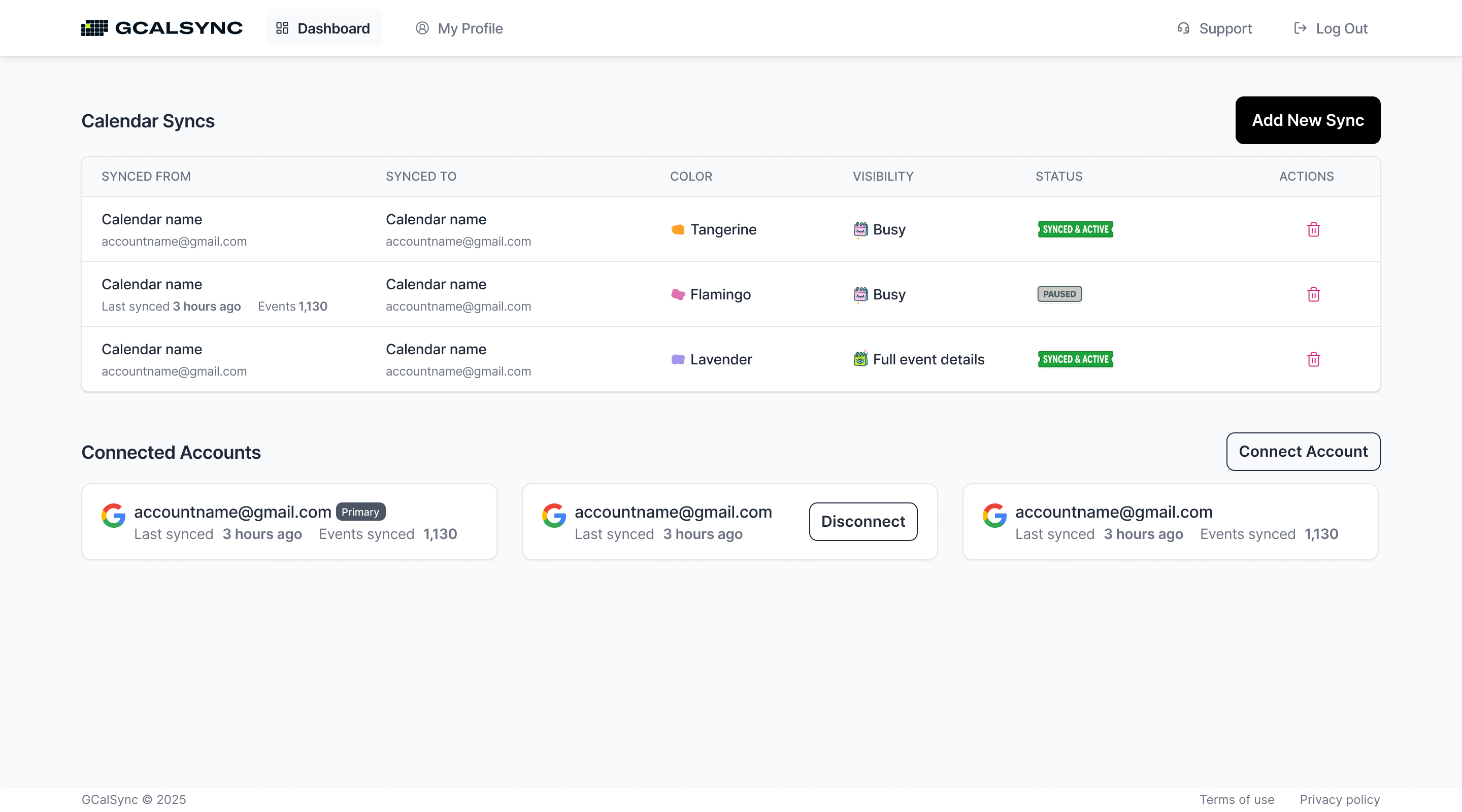
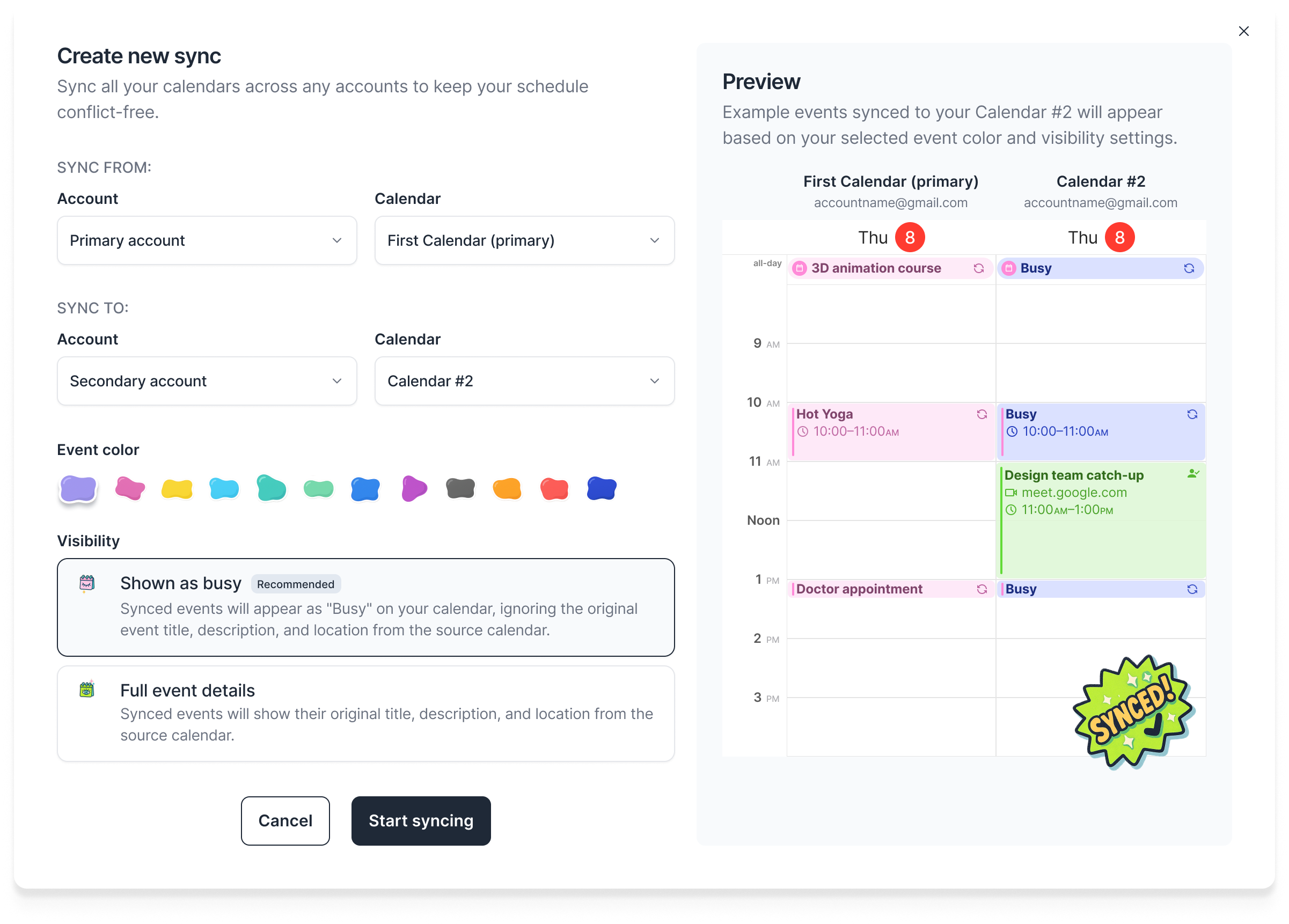
We had already seen what good looked like in parts. The best tools we tried understood that syncing is not just about copying data from one place to another. It is also about visibility and privacy. Sometimes you want full event details mirrored across calendars. Sometimes you only want to block time without exposing the reason. That is not an edge case. That is normal life.
The bigger issue was trust. The products we tried stopped feeling dependable. Syncs broke. Events looked mirrored when they were not. And when a product manages time, silent failure is hard to forgive. A calendar app does not get judged like a social product. It gets judged like a utility. If it says an event synced, the event has to be there.
That gap between a simple job and unreliable software shaped how we thought about the product. It also pushed us toward a broader point of view. We kept seeing the same pattern in the market: useful functionality buried inside bloated platforms, or narrow tools priced like entire systems. The core need was simple. The surrounding software often was not.
That is the idea at the heart of GCalSync. We do not think every useful product needs to grow into a suite. Sometimes the better move is to stay close to the core job, make it reliable, and stop there until real use gives you a reason to expand.
This project reinforced something we believe deeply as a team. Great software should feel effortless when it is done right. That standard shaped GCalSync from the start, and it is why we kept pushing for something focused, trustworthy, and clear.
A small product is not a small build
We initially thought this would take about a month.
Our initial timeline was optimistic. The scope did not expand, but the production realities became clearer as the work moved from internal workaround to real product.
One of the most important things we did right was keep the MVP scope stable. We did not keep adding features. We did not turn the roadmap into a grab bag. We stayed focused on Google Calendar sync. No Outlook in v1. No giant scheduling layer. No task management detour. No attempt to become a broader productivity platform.
That matters because it means the timeline slip taught us something useful. The project took much longer not because we were undisciplined about scope, but because shipping a product for real users, even a small one, includes much more than the happy path.
We needed authentication flows that did not feel brittle. We needed subscription logic. We needed onboarding that made sense for a product that is supposed to fade into the background after setup. We needed failure recovery. We needed a sync strategy. We needed alerts. We needed enough operational confidence that people could stop babysitting the system. We needed design clarity around what the product does, what it does not do, and how quickly a new user can understand that. Under the hood, that meant a frontend in React, a backend in NestJS, Firebase services for hosting and data, Stripe for subscriptions, and Google Calendar webhooks to keep changes flowing without turning the whole system into a polling loop. It also meant moving from rough background-job thinking toward Cloud Tasks, which gave the sync layer a cleaner operational shape once the product had to behave like a real service rather than a personal workaround.
This is where a lot of current tech discourse falls apart. Yes, building is faster now. Yes, scripts and AI-assisted prototypes can get you surprisingly far. But products that run in the background, touch sensitive data, and have to keep working when no one is looking still demand product discipline. Security, reliability, subscriptions, edge cases, recovery, and user trust are not optional because the build tools got better.
That is part of what makes GCalSync more interesting to us than a simple utility project. We also saw the limits of the current AI-assisted workflow very clearly. AI was useful for a lot of frontend work and for spinning up API scaffolding quickly, but the core sync logic did not yield so easily. Event matching, recurrence handling, schema decisions around Firebase Data Connect, and the conditions needed to keep one event correctly tied to another still had to be reasoned through and written with much more care. It became a good reminder of the difference between making something work and making something dependable.
Our core product decision: mirror, do not manage
One of the smartest choices we made was what we refused to do.
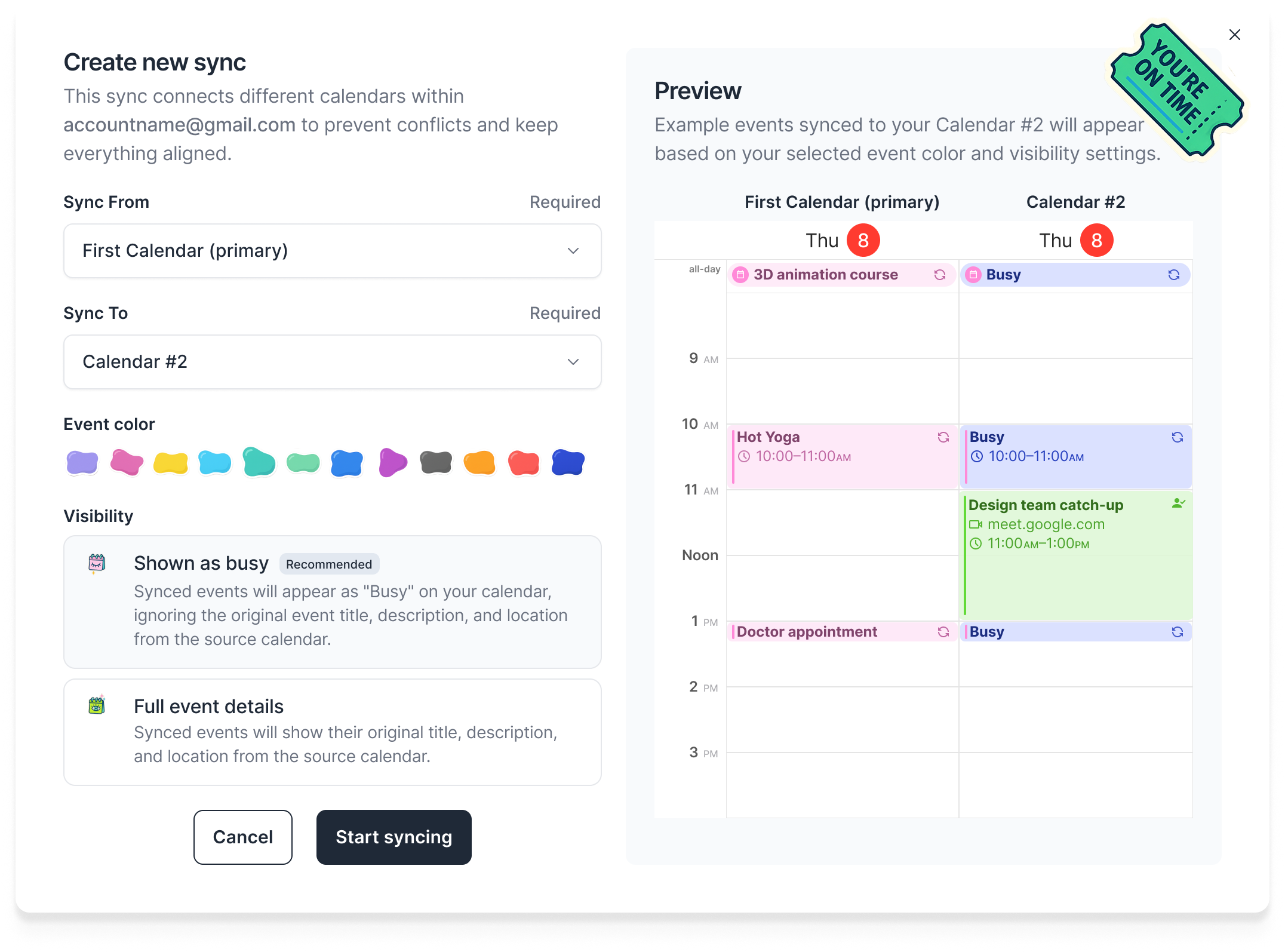
GCalSync does not pretend to solve all calendar complexity. It mirrors. It syncs. It keeps calendars aligned. It does not try to become a smarter boss than the user. That means no invented AI scheduling story. No fake automation layer doing too much. No complex conflict resolution engine dressed up as convenience. That decision also made the technical model cleaner. Instead of layering on opaque automation, we could focus on the hard but legible parts: listening for event changes, matching mirrored records correctly, and handling the ugly edge cases that show up when recurring events start to mutate, cancel, or reappear in slightly different forms.
This is not a limitation that we later turned into philosophy. It is the philosophy.
When a team sits too close to a real pain point, it is easy to overbuild. We could have gone that way very quickly. We discussed Microsoft integration. We discussed family-sharing use cases. We discussed unlisted public calendar links. We discussed scheduling. We discussed broader ecosystem possibilities. But we kept bringing the product back to the one thing we personally needed every day.
That daily use matters. It is much easier to protect a product from drifting when the builders are also the users. Every extra feature has to survive a simple test: would we genuinely want this, or are we flattering ourselves with more software?
That question saved us more than once.
Privacy was not a feature. It was the requirement.
One reason off-the-shelf tools failed this use case is that calendar syncing is not only about duplication. It is about information boundaries.
A work calendar needs to reflect that you are unavailable. It does not necessarily need the title, notes, or context of the personal event that made you unavailable. That is why privacy controls mattered so much in the earlier tools we liked, and why that idea became central to GCalSync.
The product lets users choose whether to copy full event details or just block time as busy. That sounds like a small toggle. In reality it is the kind of choice that determines whether a product fits actual professional life.
There is also an infrastructure side to that same principle. We moved tokens server-side. We tightened Google auth handling. We shifted to push notifications instead of relying on a more fragile approach. We also chose not to store users’ calendar event data on our backend, which kept the system narrower from both a security and product-design standpoint. Firebase handled a lot of the authorization model for us through token-based access and scoped queries, while separate authorization keys across environments kept the operational setup cleaner. None of that work is flashy. All of it matters. It is the difference between trustworthy software and a clever demo.
A lot of teams still talk about privacy and security as compliance topics. For products like this, they are usability topics too. The product only feels easy because the difficult questions are handled before the user ever sees them.
Designed to disappear and delight
On the surface, GCalSync is a simple utility. That is exactly why design mattered.
When a product promises to work quietly in the background, users get very few moments to form an opinion. Setup. State changes. Empty states. Confirmation. Error recovery. The interface has to do more with less.
We designed GCalSync around that reality. Minimal surfaces. Flat light backgrounds. One-pixel separators. Clear hierarchy. Sparse motion. The job of the interface is to make the sync logic understandable without making the product feel heavy.
But clarity alone was not enough. We also wanted warmth.
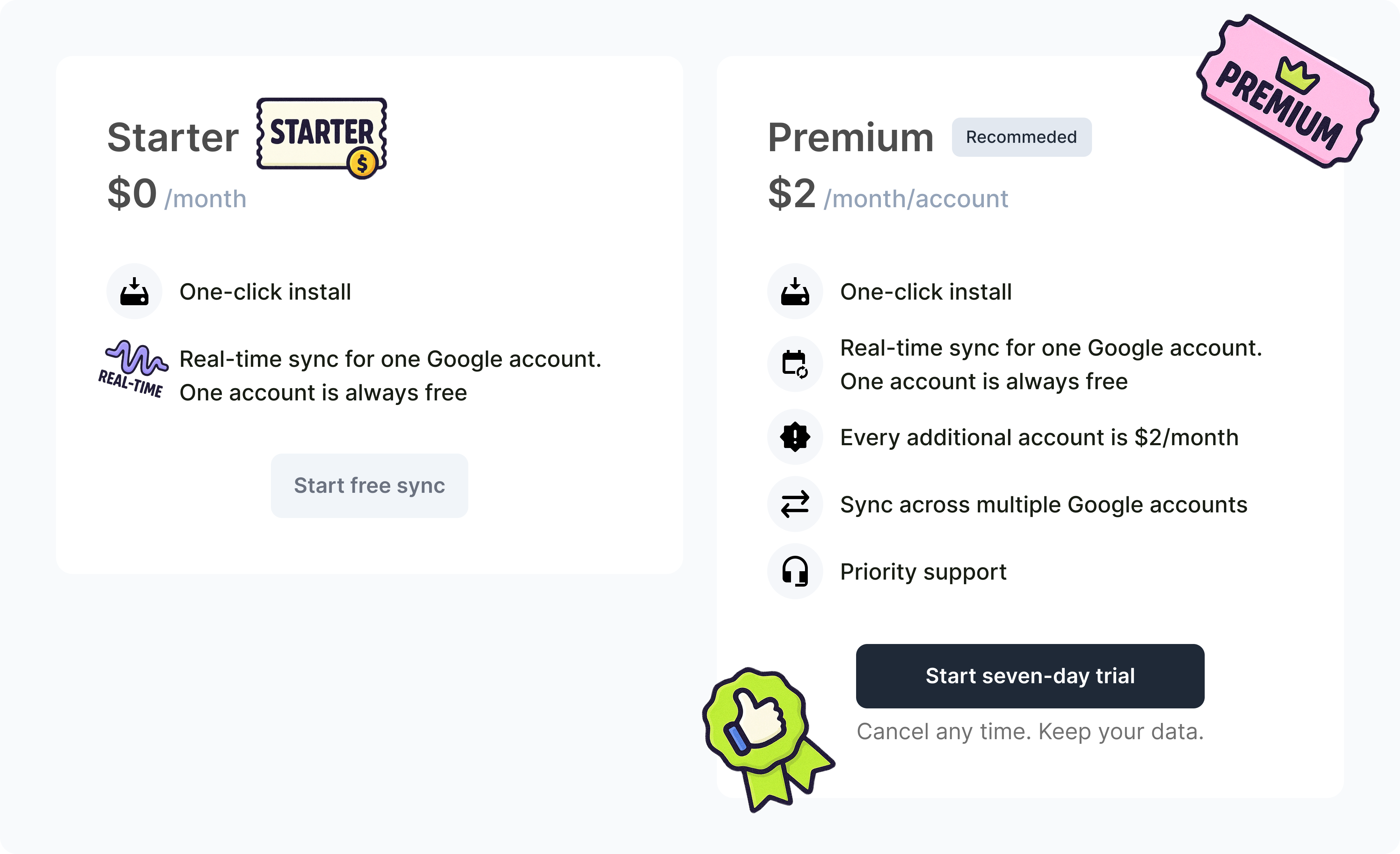
The sticker-inspired visual system became one of the most distinctive parts of the product. It was never meant to overpower the interface. The buttons stayed simple and black, while the delight came from sticker-like labels, crisp iconography, and a few carefully placed nostalgic details. Halftone shadows and limited color pops gave the product a warmer edge without turning it into costume. The goal was simple: make a utility product feel precise, clear, and a little more joyful. That restraint mattered on the implementation side too. Because the interface stayed so focused, the product could put more weight on the few moments that really mattered: connected states, sync states, error recovery, and the clarity of what exactly would be mirrored across calendars.
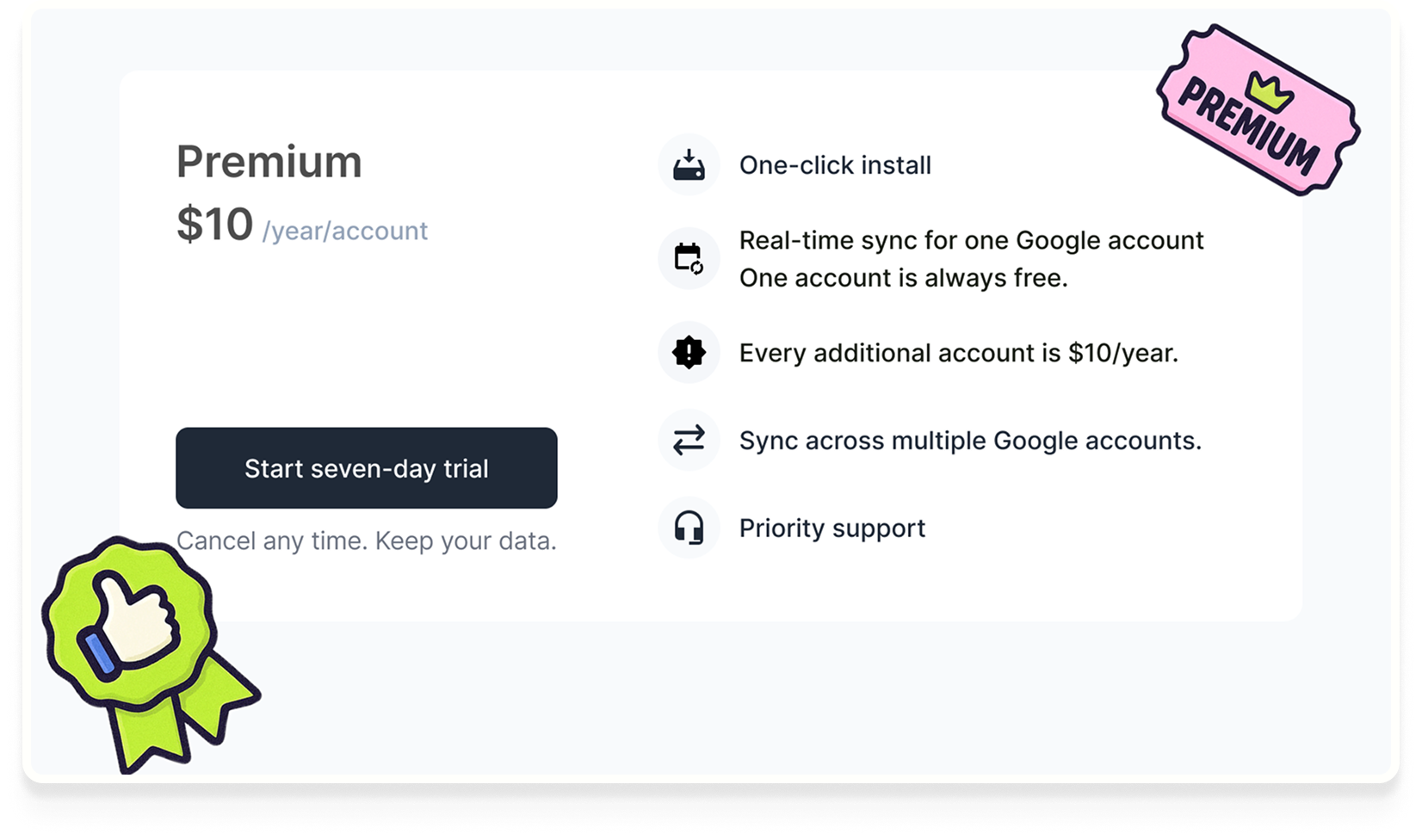
That same thinking shaped the marketing direction. We explored a landing page language with expressive 3D calendar visuals, retro-futurist textures, subtle scanline overlays, and sticker-style accents carried over from the app itself. That continuity mattered because GCalSync was doing two jobs at once. It solved an internal workflow problem, and it acted as a live portfolio piece for how we think about product design.
That is one of the more useful lessons from this project for any studio or product team. Internal tools do not have to look like internal tools. If you are already doing the work, you might as well let the work prove what you can do.
GCalSync reflects how we approach product design: stay close to the real workflow, solve the core job clearly, and build only what creates lasting value. See how our product design services help teams turn narrow workflow pain into software people actually trust.
What this project taught us about product thinking
The deeper story here is not just about calendar sync. It is about how product teams decide what kind of company they want to be.
We believe many companies get pushed into constant expansion not because users truly need more, but because investor pressure, sales pressure, and growth expectations distort the relationship between product and customer. Teams keep adding features. Sales promises outrun delivery. Product teams are left catching up. Stability gets undervalued because it does not sound as exciting as growth.
GCalSync sits in the opposite camp. We had a real internal pain point, built a narrow solution, and felt no need to turn it into a beast. That created a different product logic.
It let us ask better questions.
Does this solve the actual problem cleanly?
Does it stay reliable without constant handholding?
Does the product fade into the background after setup?
Would the next feature strengthen the core behavior or distract from it?
That mindset feels especially relevant right now. AI tools and rapid build environments have made it easier to spin up software. They have not made it easier to decide what deserves to exist, what deserves to stay small, or what deserves to be maintained instead of endlessly expanded.
We are moving into a period where the hard part is less often “can this be built?” and more often “should this become a product, and if so, how much product should it become?”
Our answer here was simple: build narrowly, run reliably, and let real use earn the next move.
The kind of proof we care about
This is not a giant launch story with inflated vanity numbers. In some ways, that makes it more useful.
Our documented goals were practical: Day-7 retention of at least 40 percent, free-to-pro conversion of at least 8 percent, and support tickets at or below 5 per 1,000 users per month. We also saw early signs that the product could attract interest beyond our team before we had really marketed it, helped by the clarity of the use case and the plainspoken name.
But the proof we care about most is quieter than that. The hardest bugs were not glamorous ones. Recurring events caused the most trouble, especially when jobs started behaving recursively and edge cases piled up faster than expected. Google’s Calendar API was workable, but one important limitation shaped the system: the incremental fetch path was not reliable enough for this use case once cancelled events entered the picture. We could fetch only changed events, or preserve enough context to reason about deletions properly, but not both in the clean way we wanted. So we optimized around that reality instead, including rate limiting to make sure the product stayed stable and never ran into avoidable rate-limit failures.
Once connected, GCalSync fades into the background. It works without constant oversight. If something fails, recovery systems exist. Alerts are in place. Scaling behaves as expected. For a utility app, that is the right success story.
A lot of product storytelling still overweights launch energy and underweights operational calm. But the real compliment for a tool like this is not “I keep checking it.” It is “I forgot about it because it kept doing its job.”
That is the kind of outcome many ambitious software companies accidentally design away from.
What comes next without losing the plot
There is a roadmap, but we do not want it to turn into drift.
Microsoft integration is the next obvious extension because the same problem exists across Microsoft and Google environments. That is a continuation of the core problem statement, not a departure from it. There is also room to improve the internals before the surface area grows much further. The sync code can still be restructured for better readability, and there is still more performance headroom to explore around incremental event fetching. That kind of cleanup matters because focused products do not stay reliable by accident. They stay reliable when the code underneath them remains understandable enough to evolve without breaking trust.
There are also interesting requests around family-facing calendar sharing, unlisted public calendar links, and deeper scheduling integrations. Some of those may become features. Some may become integrations instead of native buildouts. That distinction matters.
One of the healthier instincts we developed through this project is the willingness to ask whether a capability should be built at all. If a platform partner already handles something well, maybe the right move is not to recreate it. Maybe the right move is to fit cleanly into a tool chain.
That sounds modest. It is actually strategic.
Software companies often talk about owning the workflow. For focused products, there is another path: own the most painful step, then integrate intelligently around it.
Why this project matters to us
GCalSync is easy to underestimate because the interface is small and the use case is easy to explain. That is exactly why it matters.
It reminded us what happens when a team treats a narrow problem seriously.
It showed us the difference between a feature and a product.
It confirmed that visual craft still matters in utility software.
It proved that scope discipline can coexist with ambition.
And it reinforced something we increasingly believe about the tech industry: some of the best product strategy right now is subtraction.
Not every useful piece of software needs to grow into a suite. Not every company has to turn every bit of traction into sprawl. Sometimes the sharper move is to make one thing dependable, price it simply, let it prove itself in use, and expand only when the next step is a continuation of the same promise.
That is what makes GCalSync meaningful for us. It is not just a calendar sync app. It is a small argument for a different kind of software company.
If your team is stuck between bloated software and brittle workarounds, there is usually a sharper option in the middle. These are the product problems we like best: narrow on the surface, deep in the details, and valuable once they work so well nobody has to think about them anymore. If that sounds familiar, book a 15-minute consult with our team and we’ll help you spot where a more focused product approach could create leverage. You can see GCalSync at gcalsync.app.